Sunday

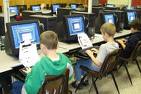
Importance of Technology in Schools

Technology is the need of the day. The technological advancements have made society take a leap towards success. Every technological reform is a small step towards advancement. Every new invention in technology is a step towards progress of mankind. Centuries ago, hardly anyone would have even dreamt of working on a computer. Generations of the yester years would have hardly imagined being able to communicate with people on the other side of the globe. But there were some intelligent minds to dared to dream of such revolutionary discoveries and they made the 'impossibles' possible. Ours as well as our future generations are lucky to be able to witness the technological reforms. We are fortunate enough to lead a life of luxury and comfort. Since ours are the times of technology, why not let the technological reform spread far and wide? Why not make the masses aware of the new technology? Why not equip the entire society with the knowledge of the new inventions in technology? The need to introduce technology at an early age in life, illustrates the importance of technology in schools.

Importance of Technology in Schools
As technology is bound to rule our present and future, it is good be obtain a know how of the technological reforms at the earliest. Children learn faster and can adapt to changes relatively easily. If they are trained during their school years, they have high chances of becoming experts in technology. An early beginning is always beneficial in the long run. When we know that technology is bound to be a part of their future, it is best to introduce them to it during school life. Instead of seeing them, struggle with learning later in life, it is advisable to give them a basic idea of the technological reforms.

Studies have shown that children conversant with technology show improvements in their writing, reading and math skills. Technology has also contributed to the decrease in drop out rates, improvement in student attendance and enhancement in their learning abilities. Technology in school benefits the children during their higher education. It lays a strong foundation of a successful professional life of an individual.

Computers can offer livelier explanations of various subjects. The Internet is an ocean of information, which can be harnessed for the rendition of information in school. The inclusion of technology in the process of learning makes learning an enjoyable activity, thus inviting greater interest from the kids. The knowledge from all around the world can be better brought about for the children and can be better assimilated by them.

The admin processes, the official procedures of school can be simplified by the means of technology. School records, the information about all the students and the teachers as also other school employees can efficiently be maintained by means of the advanced technology. The data pertaining to the school employees and students can effectively be stored in a school database. The school could have a library system, which by the utilization of technology can be maintained in an efficient manner. On similar line, the attendance records of the pupils and teachers can be maintained by means of a student database. Moreover, the school can host a website of its own holding information about the school. The introduction of technology in schools can thus result in a decreased use of paper and in bringing most of the school office work in an e-format.

Thus we see that technology not only benefits the school students but also eases the office work. It makes possible, a more effective way of storage and distribution of information. The realization of the importance of technology in schools and its successful implementation is a necessity. The introduction of technology in schools is the means to bridge seemingly log distance between the present and the future.

Wednesday

Use Google Calendar to Organize Yourself

A personal assistant can perform time management tasks for you. But if you do not have one then there is nothing to worry about. You can easily have a solution by using Google Calendar on your Desktop.The need to organize is a part of human nature especially if you are at some important position in a company; even if that is not the case, there are many people around you who expect you to remember their birthdays, wedding anniversaries and other related stuff. With the pressure of work or studies, it is physically impossible for a person to keep track of so many dates. Many of you must have had the embarrassing experience of making a commitment with your wife or a close friend for dinner or shopping and then having to cancel it because of any important meeting that was scheduled weeks ago and that somehow slipped your mind.

The desktop Google calendar helps you organize yourself in a better way. It has a number of features other than just being a plan calendar which ensure smoothness in your day to day planning. The most important feature in this regard is that it connects to your Google calendar directly, so all you have to do is to update your online calendar while checking your emails. You can put in birthday reminders, events, meetings, appointments and wedding anniversaries reminders etc. in your calendar. You will get emails and reminders on your desktop about all the upcoming events. But there is a problem here; the Google calendar on your desktop is read only meaning that you cannot update it directly like a number of other desktop applications. The editing, deleting and adding of new events has to be done from Gmail calendar.CLICK here to Download

Distance Learning Courses

No time for professional education after joining a job’, ‘Attending regular classes for higher education is monotonous’, ‘Learning by reading books is a past habit, ‘No mood for study after return from work’, ‘Job is the first priority and study the second’, ‘Not going for a regular professional development course because it is expensive’. These are merely unacceptable excuses in the present age of distance learning or online learning.

Distance learning is the preferred and popular medium of higher education in the present Internet dominated world where distance is an unheard word. Distance learning means learning away from an institute but in close touch with instructors of the institute online. Distance learning means learning at home and on the move by going online. It is better defined as learning wherever and whenever.

Benefits of Distance Learning Courses or Correspondence courses

Distance Learning Courses or Correspondence Courses have emerged as a new evolution and has greatly affected the people from all over the world. Distance Learning Courses have gained much popularity and the reason behind this is its various advantages. Earlier, Correspondence Courses were dependent on mail-in based system and those who wanted to pursue these courses had to communicate with their teachers through mail. All the study materials and assignments were sent through mail. But now with the development in technology you can easily pursue these courses. In order to get a degree through Correspondence Courses all you need is just a computer with internet connection.

Distance Learning Courses provide you with the opportunity to continue education according to your convenience. Correspondence Courses are now being preferred by more and more people as these courses equip the individuals with highly specific skills which can be helpful for their career advancement. Actually, the main objective of Distance Learning Courses is to provide education to people from every walk of life irrespective of their age. Anybody can pursue education through Correspondence Courses. There are courses for individuals belonging to different age groups.
Another important advantage of Distance Learning Courses is that you can study at anywhere and at anytime without leaving your other responsibilities. It provides the flexibility of time and location; you can even study from the comfort of your home as there is no need to attend regular classes. You can study at a time when you feel comfortable. Correspondence Courses are very beneficial for those individuals who are already working but need a special qualification for promotion in job or career advancement. They can pursue Distance Learning Courses along with their current job and fulfilling all their obligations.

Sunday

Technology in Environmental Education

In a world where we are frequently exposed to controversial high-tech headlines about self replicating miniature robots, attempts to download human brains into computers, and cars with night vision and heads up displays, (note) I am often asked what does technology have to offer environmental educators and their students? When it comes to technology, we are of two minds. We hate TV, but we have a favorite show. We hate deforestation, but we love beautiful wood-grain furniture. We hate electronic eavesdropping. But we love it when it's used to capture a fiendish criminal. Technology. We love to hate it. We hate to love it. (note.) In the next few pages, I will explore the philosophy and examples of how we try to embrace (if not love) Technology in our programs at IslandWood.

In a recent survey of environmental centers, Bethany Lesure found the most common reasons for integrating technology into educational programs are "audience demand", "State Ed. Requirement", a way to "Reach Out", and that "Kids Relate" to technology (Lesure, 2002). While these are very pragmatic reasons, I would argue that we need to be more deliberate in our choices � after all, isn't much of Environmental Education about considering the consequences of one's actions? (note.)

Integrating technology into our educational programs provides students with additional tools to enhance their learning. So you might wonder, "What are the benefits of taking this approach to help students explore and understand the world around them?"

Technology supports our efforts to appeal to different learning styles. With a variety of learning tools, students can understand their experiences through verbal, written, spatial, quantitative, and/or graphical means. As a result, many more students become engaged in the learning process.

Technology supports our multidisciplinary approach to learning. Integrating different disciplines helps students combine their mathematical, logical, scientific, linguistic, artistic, and social knowledge to make their lives and interactions with the world clearer.

BlogCatalog

Education